When most people picture a dolphin, they imagine a sleek grey bottlenose — the species most commonly seen in marine parks and nature documentaries. But dolphins are actually an extraordinarily diverse group of animals. The family Delphinidae — the oceanic dolphins — contains around 90 species, ranging in size from the tiny Māui dolphin (under 1.5 meters) to the massive orca, or killer whale, which can reach 9 meters in length and 10,000 kilograms in weight.
Yes, orcas are dolphins. This surprises many people, but taxonomically, killer whales are the largest member of the dolphin family. Understanding the full diversity of the dolphin family gives us a much richer picture of these remarkable animals and the evolutionary paths that produced them.
The Big Categories
Dolphins belong to the order Cetacea (along with whales and porpoises) and the suborder Odontoceti (toothed whales). Within this, the family Delphinidae contains the oceanic dolphins — the group most people think of when they say "dolphin." River dolphins, by contrast, belong to different families and are considered separately from oceanic dolphins.
Key Dolphin Species
| Species | Length | Weight | Habitat | Notable Feature |
|---|---|---|---|---|
| Bottlenose Dolphin | 2–4 m | 150–650 kg | Worldwide coastal | Most studied species |
| Orca (Killer Whale) | 6–9 m | 3,600–10,000 kg | All oceans | Largest dolphin species |
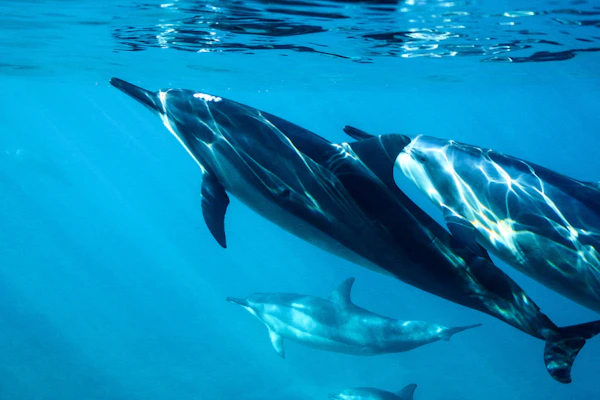
| Spinner Dolphin | 1.3–2.1 m | 23–79 kg | Tropical/subtropical | Acrobatic spinning leaps |
| Common Dolphin | 1.7–2.4 m | 70–135 kg | Temperate/tropical | Distinctive hourglass pattern |
| Risso's Dolphin | 2.6–3.8 m | 300–500 kg | Deep offshore | White scars from squid |
| Māui Dolphin | 1.2–1.7 m | 40–60 kg | New Zealand only | World's smallest & rarest |
| Pilot Whale | 3.6–7.6 m | 1,000–3,000 kg | Deep ocean worldwide | Strong social bonds |
| Pacific White-sided | 1.7–2.5 m | 90–200 kg | North Pacific | Acrobatic jumpers |
The Bottlenose Dolphin: Most Famous Species
Tursiops truncatus — the common bottlenose dolphin — is almost certainly the most studied wild animal on Earth. Their coastal habitat, social nature, and curiosity around humans have made them the primary subject of dolphin research for over 60 years. Two long-term study sites have been especially important: Shark Bay, Western Australia (studied continuously since 1984) and Sarasota Bay, Florida (since 1970), where researchers have tracked the same individuals and family lines across generations.
What these long-term studies have revealed is extraordinary: bottlenose dolphins form lasting friendships, pass on cultural behaviors, maintain complex social hierarchies, and show individual personalities that remain consistent across their lifetimes. Individual dolphins in Sarasota Bay have been tracked for over 50 years — allowing researchers to study not just individuals but entire family histories.
The Orca: The Dolphin That Rules the Ocean
Nothing quite recalibrates our sense of the dolphin family like the orca, or killer whale (Orcinus orca). Reaching up to 9 meters in length and weighing up to 10,000 kilograms, orcas are the apex predators of the ocean — nothing hunts them. They eat great white sharks, blue whales, sea lions, penguins, and almost anything else in the ocean. They hunt cooperatively in family groups using culturally transmitted techniques passed down through generations.
There are multiple distinct orca ecotypes — populations with such different diets, behaviors, dialects, and physical features that some scientists argue they should be classified as separate species. The well-studied resident orcas of the Pacific Northwest eat salmon exclusively and never eat marine mammals; transient orcas in the same waters eat seals and other dolphins but never salmon. These two groups share the same ocean but don't interbreed and don't associate socially.
The Māui Dolphin: Racing Against Extinction
At the other end of the size scale is the Māui dolphin (Cephalorhynchus hectori maui), a subspecies of Hector's dolphin found only in the shallow coastal waters off the west coast of New Zealand's North Island. It is the world's smallest dolphin species and one of the most endangered animals on Earth. As of recent surveys, fewer than 65 adult individuals survive.
The primary threat is bycatch — Māui dolphins getting trapped in fishing nets and drowning. Despite significant conservation advocacy, fishing restrictions in their habitat have not been sufficient to allow population recovery. Their slow reproductive rate (females don't begin reproducing until age 7–9 and have only one calf every 2–4 years) means that even low mortality rates can drive the population toward extinction.
River Dolphins: A Separate Branch
River dolphins deserve special mention, though they belong to different families than oceanic dolphins. These include the Amazon river dolphin (boto), the South Asian river dolphin, the Irrawaddy dolphin, and the La Plata dolphin. River dolphins face some of the most severe threats of any dolphin group — habitat loss, dam construction, pollution, and hunting have pushed several species to the brink of extinction.
The baiji (Chinese river dolphin) was declared effectively extinct in 2006, making it the first dolphin species driven to extinction by human activity. It serves as a sobering reminder of what is at stake for other river dolphin species.
Conclusion
The diversity of the dolphin family is one of the ocean's greatest wonders. From the social sophistication of bottlenose dolphins to the raw power of orcas to the precarious survival of Māui dolphins, the dolphin family presents the full spectrum of what evolution can achieve in a marine environment. Learning to see past the single image of a "dolphin" to the full richness of this family is one of the most rewarding things a nature enthusiast can do.