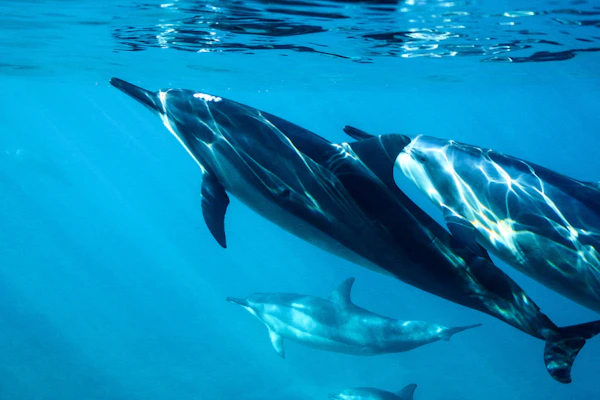
Of all the things that make dolphins extraordinary, their social lives may be the most remarkable. Dolphins don't just live in groups for safety or efficiency — they form genuine relationships, maintain long-term friendships, engage in political alliances, and live in social structures of surprising complexity. In some ways, dolphin social life parallels human social life more closely than that of any other non-primate animal.
Understanding dolphin social behavior is not just fascinating in its own right — it also provides clues about the evolution of intelligence, language, and culture. The complexity of dolphin societies appears to be a key driver of their large brains and sophisticated cognitive abilities.
What Is a Pod?
The basic social unit of most dolphin species is the pod — a group of individuals that travel, hunt, and rest together. But pods are not fixed, rigid units. In many dolphin species, particularly bottlenose dolphins, the social system is described as fission-fusion: the overall community is relatively stable, but the specific individuals associating together at any given moment change constantly throughout the day.
Imagine a community of 100 dolphins. At any given moment, these 100 individuals might be organized into 15 different sub-groups scattered across a bay. Over the course of the day, individuals move between these sub-groups constantly — meeting, splitting, regrouping. But through it all, the same 100 individuals make up the community, and relationships between specific individuals persist even when they're not together.
Friendship and Long-Term Bonds
Long-term studies of wild dolphins have definitively established that individual dolphins form preferred associations — specific individuals they spend significantly more time with than others. These associations are not random and not simply based on kinship. Dolphins have friends.
In Shark Bay, Australia, researchers have documented male bottlenose dolphins forming long-term alliances of 2–3 individuals who cooperate closely — defending each other, cooperating in competition for females, and maintaining consistent associations over years or even decades. These male alliances then form higher-level alliances with other pairs or triads — creating layered social structures with parallels to human political alliances.
Male Alliance Politics
The political complexity of male dolphin alliances in Shark Bay has been compared — only somewhat hyperbolically — to human political systems. Males form first-order alliances (2–3 individuals who cooperate closely), second-order alliances (groups of first-order alliances that cooperate with each other), and potentially even third-order alliances. Individual males may switch alliance partners over time, and the relationships between alliances shift based on competitive dynamics.
This system requires significant cognitive capacity — remembering who is allied with whom, tracking the history of relationships, and making strategic decisions about cooperation and competition based on that knowledge. It may be one reason male dolphins have particularly large brains relative to females in some species.
Mother-Calf Bonds
The most enduring social bond in dolphin life is between a mother and her calf. Dolphin calves are nursed for 3–6 years — one of the longest nursing periods among mammals — and remain closely associated with their mothers for even longer. During this time, calves learn the skills, behaviors, and social relationships they will need as adults entirely from their mothers and the social group.
This extended period of maternal dependence is one of the primary mechanisms by which dolphin culture is transmitted. Behaviors like the sponge-carrying tool use documented in Shark Bay pass from mothers to daughters because daughters spend years observing their mothers in detail. Sons eventually leave and join male alliances; daughters often remain in overlapping ranges with their mothers throughout their lives.
| Social Bond Type | Duration | Purpose |
|---|---|---|
| Mother-calf | 3–8+ years | Learning, protection, survival |
| Male first-order alliance | Years to decades | Competition, female access |
| Female friendships | Years | Social support, childcare help |
| Community membership | Lifetime | Identity, cooperation, culture |
Play: The Social Glue
Play is one of the most striking features of dolphin social life and one of the clearest indicators of their cognitive sophistication. Dolphins play throughout their entire lives — not just as juveniles. They surf waves for apparent enjoyment, play with objects (seaweed, fish, jellyfish, human debris), engage in mock combat, and create complex games with elaborate rules.
Play appears to serve multiple social functions: it builds and maintains social bonds, it allows dolphins to practice skills they'll need in hunting and competition, and it may serve as a form of social negotiation — establishing and clarifying relationships within the group. The fact that dolphins continue to play as adults (unlike most mammals, which reduce play after juvenile stages) is another parallel with humans and may be connected to the same cognitive sophistication that underlies their problem-solving abilities.
Conclusion
Dolphin social life is complex in ways that genuinely rival the social complexity of non-human primates — and in some respects, particularly in the multi-level alliance systems, may exceed it. The social demands of life in a fission-fusion community — remembering relationships, managing alliances, navigating competition and cooperation — appear to be one of the primary evolutionary drivers of dolphin intelligence. These are not simple creatures living simple lives; they are social animals navigating a richly complex world.