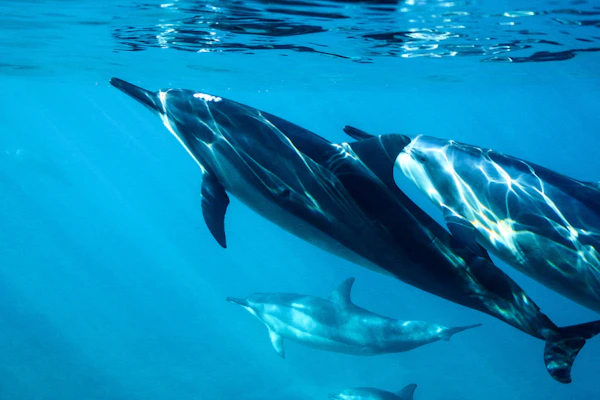
Dolphins are widely described as among the most intelligent animals on Earth — but what does that actually mean? Intelligence is a notoriously slippery concept even when applied to humans. When scientists claim dolphins are highly intelligent, they're pointing to a specific set of measurable cognitive abilities that place these marine mammals in an elite category alongside great apes, elephants, and corvids.
The evidence for dolphin intelligence is not anecdotal or based on their charming personalities. It comes from decades of rigorous scientific research — experiments that have repeatedly demonstrated that dolphins can reason, plan, communicate symbolically, recognize themselves, and even understand human gestures and grammar-like rules. Let's examine the key evidence.
The Mirror Test: Dolphins Recognize Themselves
One of the most reliable tests of higher cognitive function in animals is the mirror self-recognition test, developed by psychologist Gordon Gallup Jr. in 1970. The idea is simple: mark an animal with an odorless dye in a location it can only see in a mirror. If the animal investigates the mark on its own body after seeing it in the mirror, it demonstrates self-awareness — an understanding that the reflection is itself.
Humans pass this test around age 18 months. Great apes pass it. Elephants pass it. And so do dolphins. In studies conducted at the New York Aquarium, bottlenose dolphins repeatedly investigated marks on their bodies when placed in front of mirrors, spending significantly more time in front of the mirror when marked than when not. This places dolphins among a very small number of species with demonstrated self-recognition.
Tool Use: The Sponge Technique
Tool use was once considered a uniquely human trait. Today, we know many animals use tools — but dolphins have demonstrated particularly sophisticated tool use. In Shark Bay, Western Australia, researchers documented a population of bottlenose dolphins that use marine sponges as tools. The dolphins carry pieces of sea sponge on their rostrums (snouts) while foraging along the sandy seabed.
The sponge acts as a protective glove, shielding the dolphin's sensitive snout from stinging creatures and sharp objects on the ocean floor as they root for buried fish. What makes this especially remarkable is that the behavior is culturally transmitted — mostly from mothers to daughters — making it one of the clearest examples of animal culture ever documented. Individual dolphins choose to adopt this technique; it is not instinctive.
Language Comprehension: Understanding Grammar
In the 1980s, cognitive scientist Louis Herman at the University of Hawaii conducted landmark experiments with bottlenose dolphins named Akeakamai and Phoenix. The dolphins were taught artificial gestural languages — one based on arm gestures, one on sounds — and then tested on their ability to understand novel sentences constructed from the language's vocabulary.
The results were extraordinary. The dolphins could understand sentences of up to five elements, respond correctly to novel combinations they had never heard before, and crucially, understand that word order matters. When instructed "fetch the ball to the hoop" versus "fetch the hoop to the ball," they responded correctly to each. This demonstrated an understanding of syntax — grammatical rules — which was not thought possible in non-human animals at the time.
| Cognitive Ability | Dolphins | Great Apes | Humans |
|---|---|---|---|
| Mirror self-recognition | ✓ | ✓ | ✓ |
| Tool use | ✓ | ✓ | ✓ |
| Cultural transmission | ✓ | ✓ | ✓ |
| Understanding syntax | ✓ | Limited | ✓ |
| Named individual identity | ✓ | Uncertain | ✓ |
| Empathy / helping others | ✓ | ✓ | ✓ |
Signature Whistles: Dolphins Have Names
One of the most striking discoveries in dolphin research is that every dolphin develops a unique vocalization called a signature whistle within the first few months of life. This whistle functions as an individual identifier — essentially a name. Dolphins use their own signature whistles to announce themselves, and they respond when they hear their whistle played back to them.
Even more remarkable: dolphins copy each other's signature whistles. When two dolphins are separated, they sometimes call out each other's signature whistle — apparently trying to locate their companion. Researchers have also documented dolphins using the signature whistle of a specific individual when "talking about" that individual to others. This is behavior that strongly parallels how humans use names, and it's unique among non-human animals studied so far.
Problem Solving and Planning
Dolphins have been observed engaging in what appears to be deliberate planning and creative problem-solving. In documented cases, dolphins have used strategic deception — pretending not to notice something while waiting for an opportunity — which requires mental modeling of another animal's beliefs. They've also been documented teaching specific hunting techniques to their young, demonstrating an understanding that others lack knowledge they possess.
In aquarium settings, dolphins have spontaneously invented novel behaviors when rewarded for creativity — a remarkable demonstration of meta-cognition (thinking about thinking). In one famous experiment, a dolphin named Karen was rewarded every time she invented a new behavior. She began producing increasingly creative movements and combinations, demonstrating an understanding that novelty itself was the rewarded trait.
The Dolphin Brain
Much of what makes dolphin intelligence possible is their remarkable brain. Dolphins have the second-highest brain-to-body ratio among all animals — second only to humans. A bottlenose dolphin's brain weighs approximately 1.6 kilograms, compared to the human average of 1.4 kilograms. But size alone doesn't tell the whole story.
Dolphin brains are also highly folded — a feature called gyrification that increases the surface area of the cortex and is associated with higher cognitive processing. The dolphin's paralimbic system, associated with social and emotional processing, is especially well developed. This aligns with their complex social lives and emotional intelligence.
Emotional Intelligence and Empathy
Dolphins demonstrate clear emotional responses and appear to have genuine empathy for others — including members of other species. There are well-documented cases of dolphins supporting injured companions at the water's surface so they can breathe, sometimes for hours. Wild dolphins have been observed coming to the aid of other injured animals, including humans and whales.
Dolphins also appear to mourn their dead. Researchers have documented mothers carrying deceased calves for days, which behavioral scientists interpret as a grief response. They play, they appear to experience joy, and they can suffer from depression in captivity — all indicators of a rich emotional inner life.
Conclusion: A Different Kind of Intelligence
Dolphin intelligence is real, measurable, and in some ways genuinely startling. But it's also important to understand it on its own terms. Dolphin intelligence evolved to solve dolphin problems — navigating complex social relationships in three-dimensional marine environments, cooperative hunting, long-distance communication, and raising young in a challenging ocean world. In these domains, dolphins are extraordinary.
Rather than asking how dolphin intelligence compares to human intelligence, it may be more productive to ask: what does a mind optimized for the ocean actually look like? The answer, it seems, is something remarkably sophisticated — and surprisingly familiar.